
Oviedo, FL · Garage Door Service
What Happens to Your Opener When the Power Outages Out
Oviedo homes built between 1964 and 2013 often run openers without battery backup, which matters most when a power outage hits. Here's what to check first.
- Repairs & new doors
- Springs & openers
- Serving 5 nearby communities
How Local Conditions Play In
Oviedo's housing stock runs from 1964 up through 2013, with the median landing around 1984. That matters more than it sounds like it should, because garage door openers have a working life of roughly 10 to 15 years before the motor, logic board, or capacitors start to fail. A lot of houses across the 33 named areas that make up this stretch of the territory were built in the 1980s and 90s, which means a sizable chunk of openers out there are either original replacements from the 90s or early-2000s units that are now well past their rated service life. Add the mild temperate climate band this area sits in, and the failure pattern isn't about frozen tracks or cracked housings from deep cold. It's slower than that: heat and humidity over decades wear down capacitors, corrode contact points, and degrade the plastic gears inside chain-drive units. When a power outage hits a house running one of these older motors, there's often no battery backup at all, because that wasn't standard equipment when the unit went in. The door stops wherever it was when the power dropped, and depending on the opener, getting it moving again by hand isn't always obvious.
When to Get Help
Call if the opener doesn't respond at all after power comes back, even with the wall switch and remote both tried. Call if the manual release cord is stuck, frozen, or the trolley won't disengage from the rail when you pull it. Call if you smell anything burnt near the motor housing or hear a hum with no movement. Those point to failed capacitors or a dead motor winding, not a loose wire. One honest limitation: if the opener is an older chain-drive unit from the 80s or 90s and the logic board has failed, we usually can't source an exact replacement board. At that age, replacing the whole opener is almost always the better call than chasing parts for a unit that's going to fail again in another system within a year or two anyway. We'll tell you straight if that's where you're at instead of billing you for a patch job.
Checking It Yourself
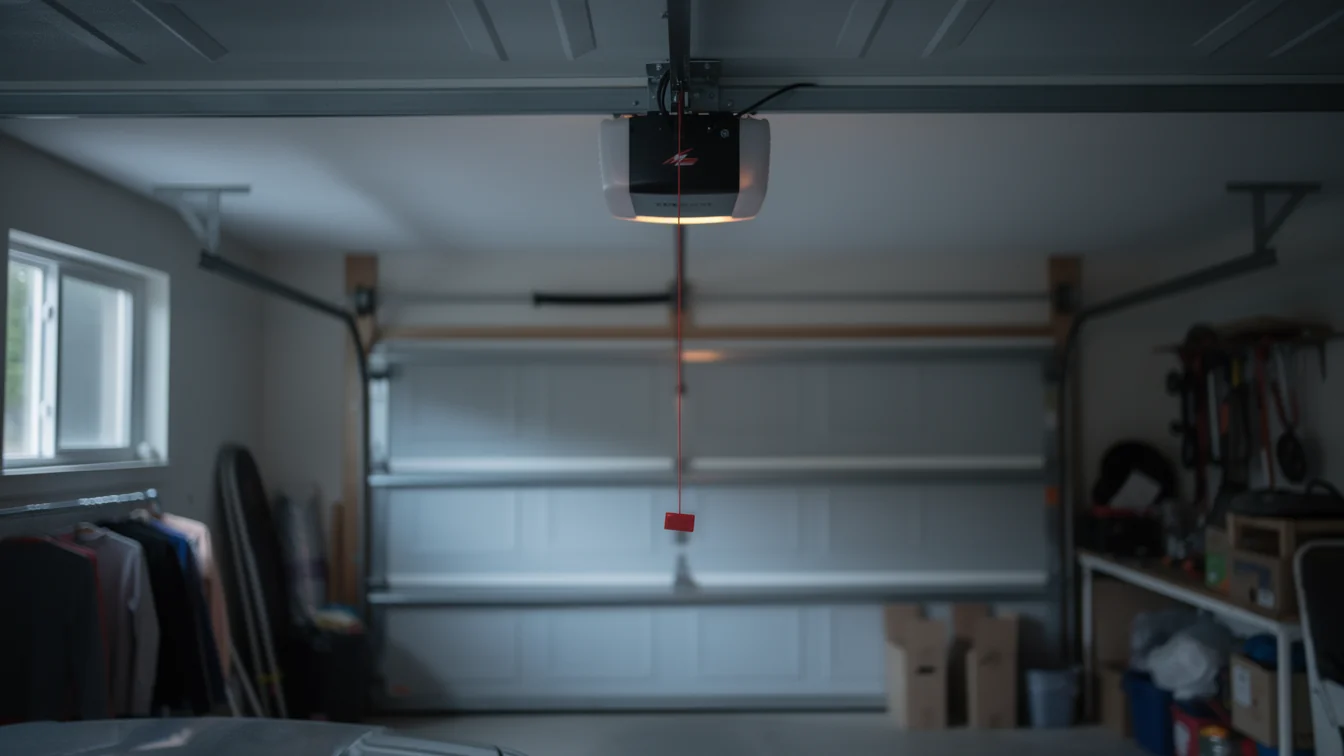
Before you call anyone, a few checks take five minutes. First, find the circuit breaker for the garage and confirm it hasn't tripped - a power outage sometimes trips it even after utility power is restored. Second, if your opener has a battery backup (check for a small battery compartment on the motor housing, common on units installed in the last decade or so), pull it and look for corrosion or a swollen case; a dead backup battery won't hold charge even once main power is fine. Third, locate the manual release cord - usually red, hanging from the trolley rail - and pull it straight down to disconnect the door from the opener. With the door disconnected, lift it by hand. If it moves smoothly and stays where you put it, the opener itself is the problem, not the door or springs. If it's heavy, drops fast, or won't stay up, that's a spring or cable issue, which is a separate repair and not something to force with the opener disconnected.
What Is Going On
A power outage doesn't usually damage an opener outright. The problem is what the opener was built to handle when it went in. Units installed when most of this area's housing went up, through the 1980s and 90s, didn't come with battery backup as a default feature - that became common much later. So when power drops, the door just stops, full stop, with no fallback system to finish the cycle or hold position. On newer installs with battery backup, a cut just means the opener switches to battery power, usually with a visible light or beep, and keeps working at reduced speed until main power returns. The actual failure people run into after a cut usually isn't the outage itself - it's that the outage exposed a motor or board that was already near the end of its life from age and humidity exposure, not from the power event. A sudden surge when power snaps back on can also finish off a capacitor that was already weak. That's why two houses on the same street, hit by the same outage, can have completely different outcomes depending on how old the opener already was.
Frequently asked questions
Why does my garage door opener stop working every time the power goes out, but my neighbor's doesn't?
It usually comes down to age and equipment, not the outage itself. Openers installed with battery backup switch over automatically and keep running. Older units, common in houses built through the 1980s and 90s, never had that feature, so they just stop dead until power returns and someone resets them.
Is it worth adding battery backup to an older opener?
If the opener itself is still within its working life, a battery backup add-on can make sense. But if the motor or board is already decades old, putting a backup battery on a unit that's near failure anyway usually isn't the better use of money. We can tell you which situation you're in during a visit.
My door won't move by hand even after I pulled the manual release.
That points to a spring or cable problem, not the opener. A properly working door should lift and hold with the opener disconnected. If it's heavy or drops, don't force it - that's a separate repair involving the torsion or extension spring system, and it's not safe to keep working at manually under tension.
Related garage door services in Oviedo
More garage door guides
Book garage door service in Oviedo
Call now or request a quote - tell us what the door is doing and where you are.